
Let me ask you something, and I want you to be honest with yourself.
When someone says, ‘Can I check out your website?‘ — what happens in your body?
Does your stomach do a little drop? Do you immediately say something like, ‘Oh, it’s a little outdated — I’m working on it’? Do you almost wish they wouldn’t look?
If any of that sounds familiar, you’re dealing with something I call website shame. And you are far from alone.
In my 30+ years of helping coaches, consultants, and service providers build and grow their businesses online, website shame is one of the most common — and most expensive — things I see. It’s not talked about enough. So today we’re talking about it.

What Is Website Shame?
Website shame is the quiet embarrassment — sometimes a low hum, sometimes a loud cringe — that happens when your online presence doesn’t match your actual level of expertise.
It’s the gap between the transformation you deliver to your clients and the first impression your website makes on the world.
It shows up as avoidance.
You STOP sending people to your site.
You STOP promoting yourself.
You STOP talking about what you do because every conversation might end with someone asking for your link — and you’d rather they didn’t go there.
Website shame isn’t about vanity. It’s not about wanting something Instagram-worthy.
It’s about the very real, very costly disconnect between your value and your visibility online.

How Does It Happen to Smart, Experienced People?
Here’s what I see over and over again:
You built your site years ago when you were just getting started. It made sense then. But your business has evolved — your niche, your services, your prices, even your whole approach — and the website never caught up.
Or maybe you hired someone who made it look nice, but they didn’t understand your business strategy. So it looks good but doesn’t actually work — no clear message, no compelling call to action, no logical path for your visitor to follow.
Or you’ve been too busy serving clients to fix it. Ironic, right? The very success you’ve built has kept you from building the foundation that would bring you more of it.
The website was always going to be the ‘next’ project. Next quarter. After the launch. After the summer. And somehow, next never came.
Do You Have Website Shame? Here’s How to Know.
Sometimes website shame is obvious. Sometimes it’s so quiet you don’t even realize it’s running in the background. See how many of these hit home:
- You haven't shared your website link on social media in months
- You say "it's a little outdated" before anyone even asks
- You typed your own URL and cringed a little
- Your website still describes a service you no longer offer
- You have no idea what your website actually says because you avoid looking at it
- You've sent someone directly to your booking link — so they wouldn't have to see your homepage first
- A prospect asked about your rates and you thought, "If they saw my website, they'd never pay that"
- You've been meaning to "fix it" for more than six months
- Someone complimented your work and you quietly hoped they wouldn't Google you
- You feel a low-grade guilt every time someone mentions your website
If you checked even three of those, website shame is already affecting your business. And the longer it goes unaddressed, the more it costs.

What Website Shame Is Actually Costing You
Here’s where I want to get real with you, because this is important.
Website shame doesn’t just make you feel bad. It has direct, measurable consequences for your revenue.
When you’re embarrassed by your website, you stop driving traffic to it.
You STOP mentioning it in conversations.
You STOP posting your link on social media.
You go quiet — and quiet means invisible, and invisible means broke.
When your site looks like a first draft, you get treated like a first draft. Prospects question your pricing. You start to justify your rates instead of confidently presenting them. You discount when you shouldn’t. And every time you do, a little bit of your confidence goes with it.
You’re also losing referrals you’ll never know about. Someone hears about you, Googles you, lands on your site, and . . . clicks away before they ever reach out. You’ll never know they were there. That’s a prospect lost BEFORE the conversation even started.
And here’s the one that really gets me: website shame erodes your confidence in ways that go way beyond the website itself. When you don’t believe in your own presence, you hesitate. You apologize before you pitch. You shrink — and shrinking is not a revenue strategy.
From “I Knew It Wasn’t Working” to Booked Before Launch
Sabrina Hammonds of Kingdom Connections came to me knowing something was wrong — she just couldn’t put her finger on what.
“I knew what God had put in my heart. I knew the message,” she told me. “But I couldn’t see it visually on my website.”
She had been paying for a website that wasn’t converting. She knew it. But like so many experienced, gifted professionals, she didn’t know how to fix what she couldn’t fully articulate.
What she needed wasn’t just a redesign. She needed someone to look at her site honestly and tell her the truth — and then actually do something about it.
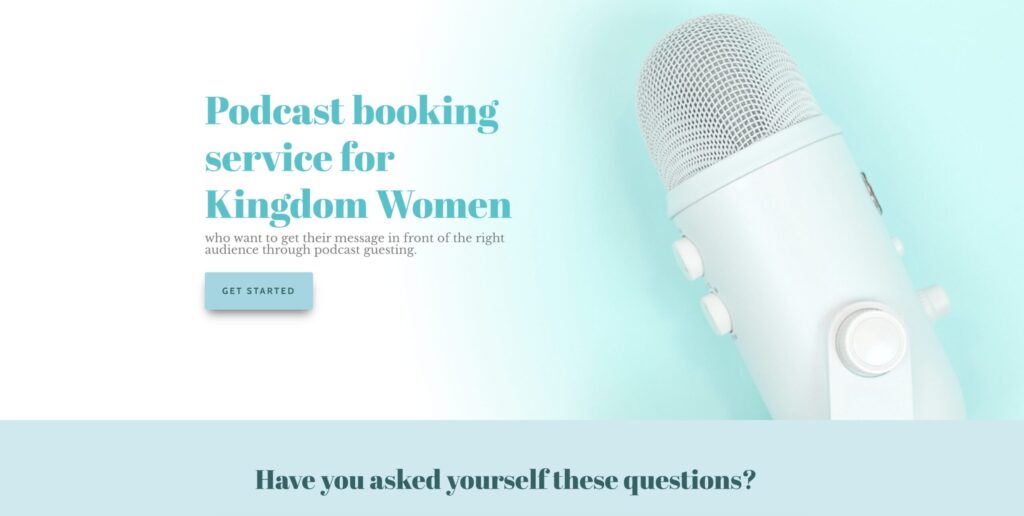
On our very first call, I walked her through what I saw: a site that wasn’t showcasing who she was, wasn’t bringing in clients, and needed real work. I wasn’t rude about it — just honest.
Sabrina said that directness was actually what won her over, because others who had looked at her site weren’t willing to say the hard things.
From there, she shared everything — her heart, her message, how she wanted people to feel when they landed on her site, what she wanted them to walk away with. And we built something that captured all of it.
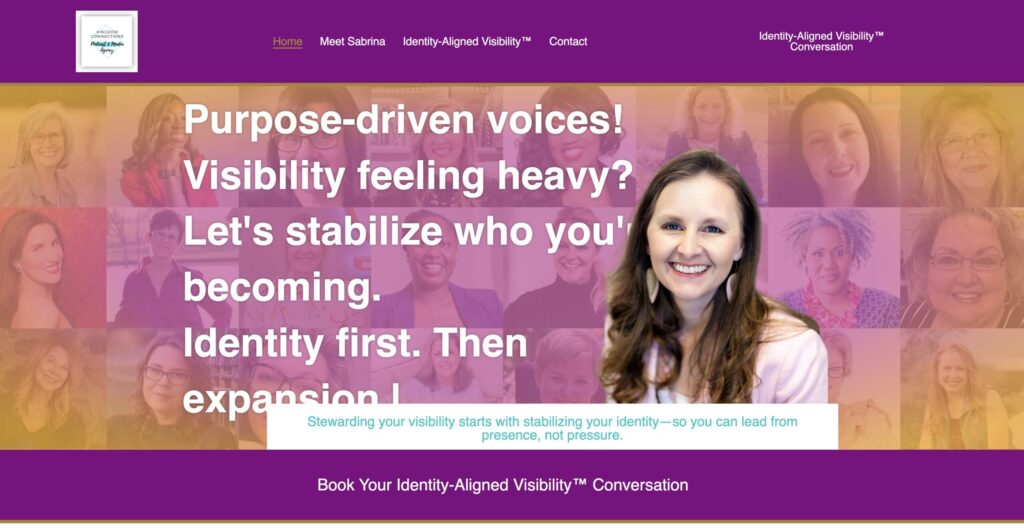
Here’s the part that still gives me chills: before Sabrina had promoted her new website to a single person, someone booked a call through it. The only way they could have found the link was through the site itself.
“The website that I had been using was not really bringing anyone to me at all,” she said. “And then I get a call on my calendar — and I hadn’t even shared it yet.”
That is what happens when your website finally matches your message.
So What Does a Website That Actually Works Look Like?
Let’s flip the script for a minute. Instead of talking about what’s broken, let me show you what right looks like — because a client-converting website isn’t mysterious. It’s intentional.
Here are the non-negotiables:
A headline that speaks to one specific person.
Not “Welcome to my website.” Not your name in big letters. A headline that makes your ideal client think, “She’s talking to me.” Something like: “I help burned-out coaches build a business that works without working you into the ground.” Specific. Direct. Immediately clear.
An audience callout above the fold.
Within the first few seconds, your visitor should be able to confirm they’re in the right place. Name who you serve. If they don’t see themselves in your first paragraph, they’re already gone.
One strong, clear call to action.
Not five buttons. Not a menu with twelve options. One primary next step — book a call, grab the free resource, explore the services. When everything is a priority, nothing is. Pick one and make it obvious.
Trust signals that do the convincing for you.
This is where testimonials, client results, years of experience, and recognizable logos live. Social proof doesn’t just look good — it does the heavy lifting of building confidence before a prospect ever reaches out. A visitor who feels safe is a visitor who takes action.
Copy that sounds like a conversation, not a brochure.
Your website should read the way you talk. Warm, direct, specific. If it sounds like it could belong to any service provider in your industry, it’s not working hard enough for you.
Check out what some of our clients are saying . . .
When all of these elements work together, your website STOPS being a digital brochure and STARTS being your best salesperson — one who works 24 hours a day, never takes a sick day, and never apologizes for your prices.

The Prescription: What to Do About It
Here’s the truth I want to anchor everything on: your website is not a project. It is not a to-do list item you check off and forget.
Your website is a business asset — and it needs to be managed strategically.
So let’s talk about where to start.
Before you touch a single design element, get clear on three things:
Number 1: WHO you serve
Number 2: WHAT problem you solve for them
Number 3: and WHAT makes your approach distinct — your HOW
Every other decision — layout, copy, colors, pages — should flow from those three answers. Design without that clarity is just decoration.
Every page on your website needs one job.
Your homepage’s job is to quickly communicate who you help and invite them to take the next step — not to explain your entire backstory.
Your services page’s job is to help the right people say yes and let the wrong people self-select out.
Your about page’s job isn’t to list your credentials — it’s to make your visitor feel safe choosing you.
And before any of that can happen effectively, you need a plan. A real, strategic plan. Not a mood board, not a Pinterest collection, not a list of websites you like. A written strategy that maps out what each page needs to accomplish, who it’s speaking to, and what you want visitors to do next.
This is exactly why I created the WOW! Website Planner.
Your Next Step: The WOW! Website Planner
 The WOW! Website Planner is a strategic planning resource I developed based on 30 years of building client-converting websites for coaches, consultants, and service providers. It walks you through the thinking process before the building process — which is the step most people skip, and exactly why so many websites fail to convert.
If you’re ready to stop avoiding your website and start using it as the powerful business tool it was meant to be, this is your starting point. It costs less than a single lost client — and it’ll help you make sure you stop losing them.
→ Grab the WOW Website Planner here
Your expertise deserves a website that shows up in the room the way you do. Let’s build that.
Are you suffering with Website Shame?
Let us know in the comments.


